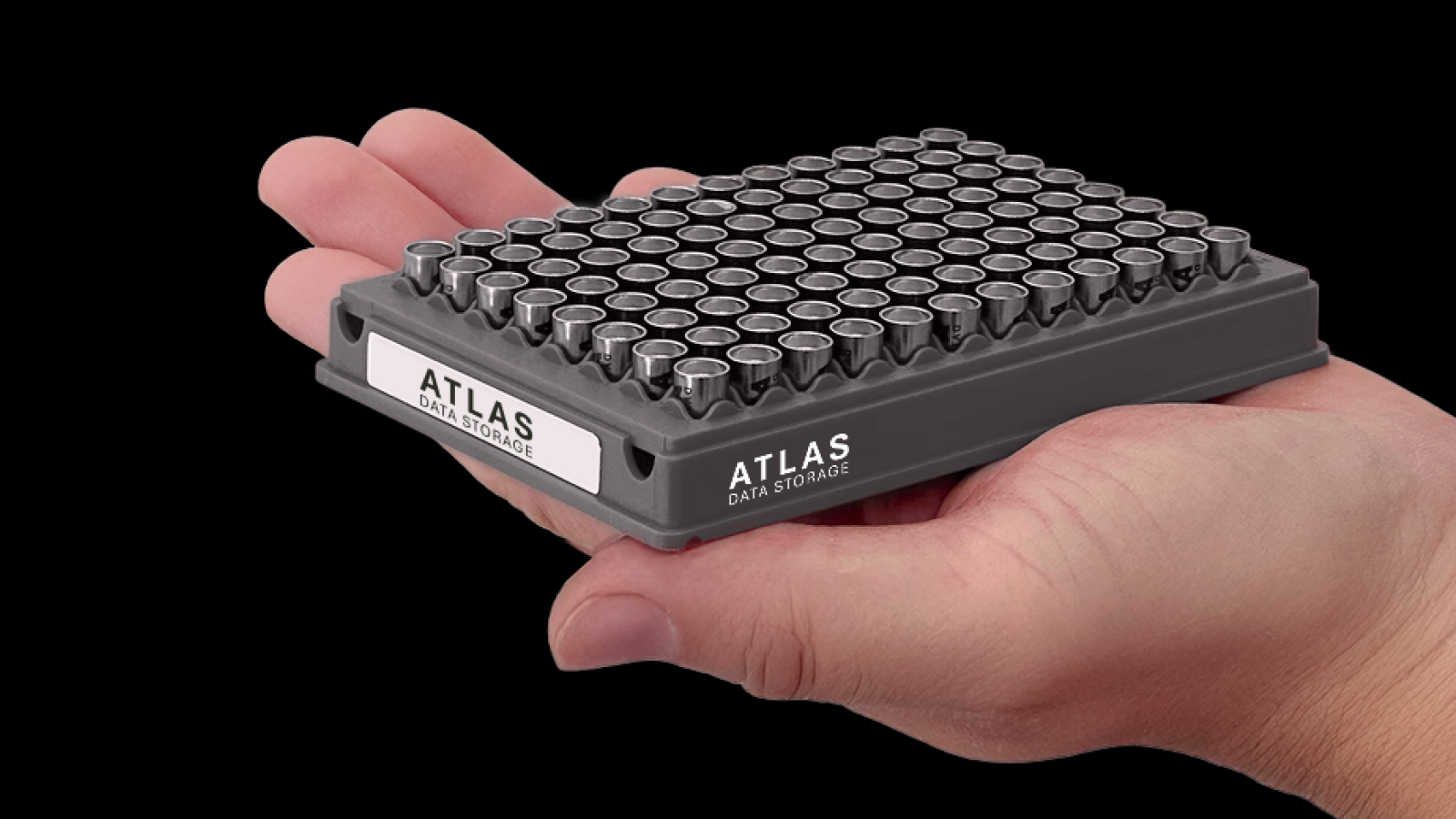

"Revolutionizing Data Storage: Atlas Eon 100’s DNA Technology Can Hold 1,000 Times More Than Magnetic Tape!"
Atlas Data Storage Launches Revolutionary DNA-Based Data Storage System
Date: October 10, 2023
Location: San Francisco, CA – In a groundbreaking development for data storage technology, U.S. biotech company Atlas Data Storage has unveiled its latest product, the Atlas Eon 100, a synthetic DNA storage system that promises to revolutionize how humanity archives its most valuable digital assets. Announced on December 2, 2023, this innovative solution claims to hold 1,000 times more data than traditional magnetic tape, positioning itself as a game-changer in the realm of long-term data preservation.
A New Era of Data Storage
The Atlas Eon 100 is designed to safeguard humanity’s "irreplaceable archives," which encompass a wide array of digital content, including family photos, scientific research, corporate records, cultural artifacts, and master versions of digital artworks, movies, manuscripts, and music. Bill Banyai, the founder of Atlas Data Storage, emphasized the significance of this launch, stating, “This is the culmination of more than ten years of product development and innovation across multiple disciplines. We intend to offer new solutions for long-term archiving, data preservation for AI models, and the safeguarding of heritage and high-value content.”
How DNA Data Storage Works
At its core, DNA data storage operates on the principle that both digital data and DNA consist of sequences. Digital data is represented as binary code (1s and 0s), while DNA is composed of sequences of four chemical bases: adenine (A), cytosine (C), guanine (G), and thymine (T). In the Atlas Eon 100 system, a specific encoding scheme maps binary code to these bases—assigning A as 00, C as 01, G as 10, and T as 11. The resulting artificial DNA is synthesized and stored in a dehydrated powder form within ruggedized steel capsules measuring just 0.7 inches tall (1.8 cm). This DNA is rehydrated only when it needs to be sequenced, allowing for the translation back to binary.
Unmatched Storage Density
One quart (one liter) of the DNA solution can hold an astonishing 60 petabytes of data—equivalent to approximately 10 billion songs or 12 million HD movies. In comparison, to store the same amount of data using conventional magnetic tape, one would require about 15,500 miles (25,000 km) of 0.5-inch-wide (12.7 mm) LTO-10 tape, a standard high-capacity storage medium. This remarkable storage density not only simplifies the transportation of large data quantities but also ensures long-term stability; DNA is known to maintain its integrity for centuries.
Atlas Data Storage claims that the Atlas Eon 100 offers a reliability rate of 99.99999999999% in typical office environments, withstanding temperatures as high as 104°F (40°C). In stark contrast, magnetic tape typically decays within a decade, even under optimal temperature and humidity controls.
Addressing the Data Explosion
As society generates an estimated 280 petabytes of data every minute, the Atlas Eon 100 presents a potential solution to the burgeoning data crisis exacerbated by the rapid growth of artificial intelligence (AI) technologies. However, the company faces significant challenges in scaling its operations. The process of synthesizing encoded artificial DNA remains time-consuming compared to conventional data storage methods. Currently, the lead time for DNA synthesis is between 2 and 8 business days, according to Twist Bioscience, Atlas’s former parent company.
Cost and Efficiency Challenges
While the potential of DNA storage is immense, the costs associated with sequencing and synthesizing DNA remain high. It costs approximately $30 to read one gigabase of DNA, equivalent to about 250 GB of data. Moreover, sequencing can take considerable time, with some solutions reporting recovery times of up to 25 minutes for a single file. Despite these hurdles, Atlas Data Storage asserts that advancements in modern DNA sequencing technology are improving throughput and reducing costs at a rate faster than Moore’s Law.
Expert Opinions and Future Prospects
Despite the excitement surrounding the Atlas Eon 100, experts express caution regarding its commercial viability. Professor Thomas Heinis from Imperial College London, who specializes in DNA-based data storage, highlighted the need for concrete performance data. He noted that while the technology is promising, the high costs of synthesis present a significant barrier to widespread adoption. “If the write/synthesis cost is not competitive, then there is no point in reading/sequencing cost efficiently,” he stated.
The DNA Data Storage Alliance has indicated that it may take another three to five years before DNA storage can be utilized for archival purposes at scale. As the industry evolves, the Atlas Eon 100 stands at the forefront of a potential data storage revolution, offering a glimpse into a future where our digital legacies can be preserved for millennia.
Conclusion
The launch of the Atlas Eon 100 marks a significant milestone in the quest for efficient, long-lasting data storage solutions. As the world grapples with an ever-increasing volume of digital information, innovations like these could redefine how we think about data preservation, ensuring that our most cherished memories and critical information remain accessible for generations to come.