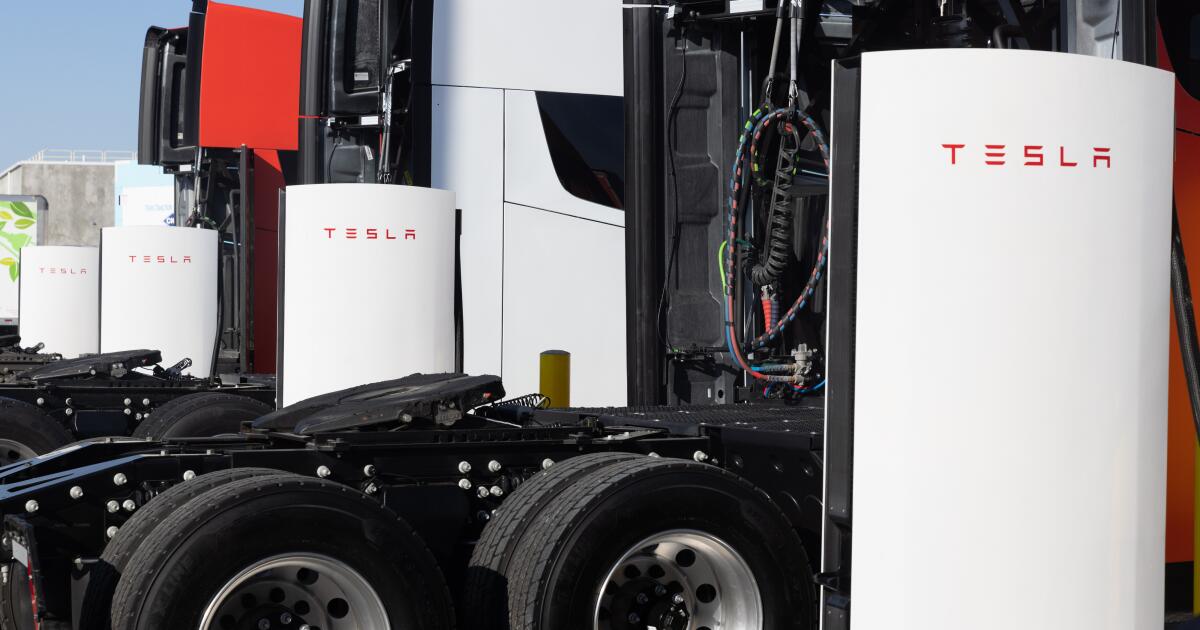

"California’s Clean-Air Initiative Sparks Controversy: Is Tesla’s Semi-Truck a Game-Changer or a Gamble?"
California’s Clean-Air Program Faces Backlash Over Tesla Semi Funding
California — A clean-air initiative aimed at electrifying the state’s truck and bus fleets is under fire for its decision to allocate a significant portion of its funding to Tesla’s all-electric Semi truck, a vehicle that critics argue remains largely unproven and beset by production delays. The California Air Resources Board (CARB) and its nonprofit partner CALSTART have reserved nearly 1,000 vouchers, totaling at least $165 million, to subsidize the Tesla Semi, which promises a range of up to 500 miles on a single charge.
Funding Allocation and Industry Response
The funding was awarded through the Hybrid and Zero-Emission Truck and Bus Voucher Incentive Project (HVIP), a program established in 2009 to reduce pollution in the goods movement sector. Since its inception, the HVIP has allocated over $1.6 billion to assist fleets in purchasing electric and low-emission vehicles. Heavy-duty trucks, while constituting only 10% of vehicles on U.S. roads, are responsible for a staggering 45% of smog-forming nitrogen oxides and 58% of soot emissions.
However, the decision to prioritize Tesla has sparked outrage among competitors in the trucking industry. Critics argue that the state has provided preferential treatment to a company that has yet to deliver a widely available product. “I don’t think it would be an overstatement to say this is market distortion or market manipulation,” stated Alexander Voets, general manager at RIZON Truck USA. “CARB essentially single-handedly just made Tesla the market leader for electric heavy-duty trucks without them having virtually any vehicles in customer hands.”
Questionable Qualifications and Oversight Issues
The controversy deepens when examining the qualifications for receiving HVIP vouchers. To qualify, manufacturers must obtain a zero-emission powertrain certification and have their vehicles listed in the HVIP catalog. Despite this, the 2024 Tesla Semi was listed as eligible by CARB, even though it lacked the necessary powertrain certification at the time of application. A senior official from another EV manufacturer expressed concern, stating, “I still haven’t seen any proof that Tesla has been able to satisfy the requirements.”
State data has also undergone significant revisions, reflecting lower funding amounts for Tesla and other manufacturers. Initially, Tesla appeared poised to receive up to $202 million, but after adjustments, the amount was revised to around $165 million. This funding is still substantially higher than that of competitors, with New Flyer, a Canadian bus manufacturer, receiving about $68 million.
Implications for the EV Market
The funding surge for Tesla comes on the heels of a policy change that eliminated the cap on the number of vouchers a single manufacturer can secure at one time. This change has allowed larger manufacturers to dominate the funding landscape, leaving smaller companies struggling to compete. “If this doesn’t get corrected, our whole industry will just go down the toilet,” warned Peter Tawil, director of sales and marketing at RIZON.
The competition for state vouchers is fierce, with funding often allocated on a first-come, first-served basis. In a recent funding cycle, 68% of the available $335.6 million was claimed within just two days. This rapid allocation has enabled companies like Tesla to secure large portions of funding without having the inventory to deliver vehicles promptly.
Tesla’s Production Delays and Future Outlook
Tesla’s journey with the Semi has been fraught with delays since its unveiling in 2017. Initially slated for production in 2019, the timeline has been pushed back repeatedly, with early customers like PepsiCo still waiting for their orders. State officials anticipate that many of these orders may not be fulfilled until late 2026.
Despite the uncertainty surrounding the Tesla Semi, the vehicle has been touted as a revolutionary solution for reducing emissions in the trucking industry. However, its design has also raised concerns; during testing at the Port of Long Beach, a significant flaw was identified when drivers found they could not roll down the windows to present necessary paperwork at gated entries.
Conclusion
As California grapples with its ambitious clean-air goals, the controversy surrounding the Tesla Semi funding highlights the complexities of incentivizing electric vehicle adoption. With significant public funds at stake, the need for transparency and accountability in the allocation of these resources has never been more critical. As the state navigates this challenging landscape, the future of the electric truck market remains uncertain, with calls for reform growing louder among industry stakeholders.