
"Reviving Coral Reefs: How Probiotics Are Paving the Way for Healthier Montastraea Cavernosa Colonies"
This heading captures the essence of the research while emphasizing the hopeful aspect of the findings.
Probiotic Treatment of Montastraea cavernosa Colonies: A Promising Approach to Coral Disease Mitigation
In a groundbreaking study published in Frontiers in Marine Science, researchers have explored the potential of a probiotic treatment to combat the devastating stony coral tissue loss disease (SCTLD) affecting coral colonies off the coast of Florida. This innovative approach utilizes a beneficial bacterial strain, MCH1-7, which was first identified by scientists from the Smithsonian Marine Station in 2018. The strain was discovered on a coral colony that exhibited natural resistance to SCTLD, raising hopes for a sustainable solution to coral health.
The Role of MCH1-7 and Tetrabromopyrrole
The study focuses on a compound produced by MCH1-7 known as tetrabromopyrrole (TPB). Researchers hypothesize that TPB may serve as a natural settlement cue for coral larvae, encouraging them to settle in areas where the bacteria thrive. Jennifer Sneed, a biologist at the Smithsonian Marine Station, emphasized the significance of this compound, stating, “If TPB is a natural settlement cue, and if bacteria that also produce this compound protect corals from disease, it makes sense that larvae would settle where those compounds are being produced.”
Methodology: Whole-Colony Bagging Technique
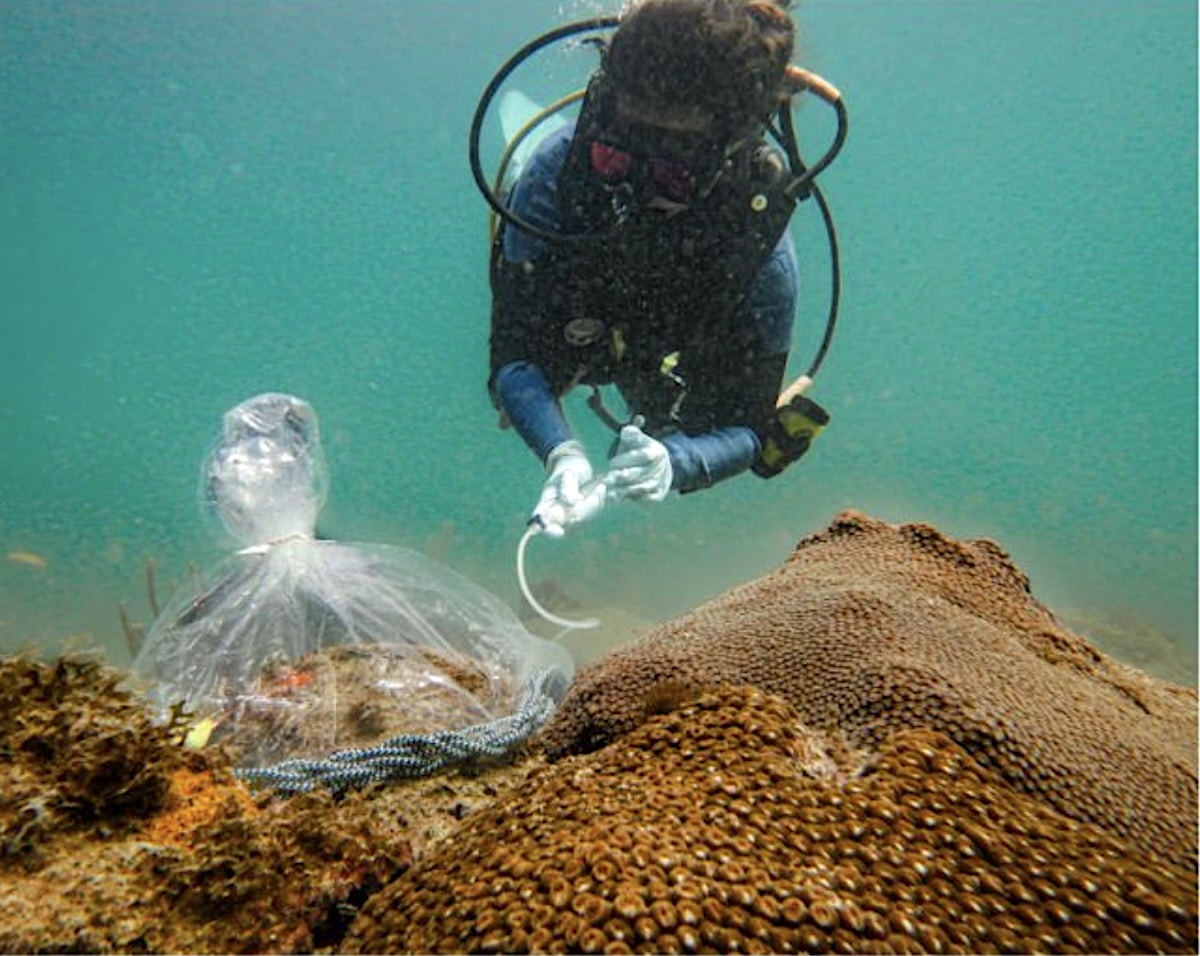
To evaluate the effectiveness of the probiotic treatment, researchers employed a whole-colony bagging technique. This involved two methods of application: injecting the probiotic into seawater contained within a weighted bag placed around the coral, and applying a paste directly to lesions caused by SCTLD. The whole-colony method allowed for a comprehensive assessment of treatment effectiveness across entire coral colonies.
Over a period of 2.5 years, the team monitored the health of the treated corals, specifically the great star coral (Montastraea cavernosa). Results indicated that corals subjected to the whole-colony treatment experienced only a 7% loss of tissue due to SCTLD, in stark contrast to untreated corals, which lost an average of 35% of their tissue. This significant reduction in tissue loss highlights the potential of probiotic treatments to enhance coral resilience against disease.
Limitations and Future Directions
While the whole-colony bagging method proved effective, the paste application to individual lesions did not yield similar results. In response, researchers developed a scuba diving technique to apply the probiotics without disrupting other healthy coral species in the Caribbean. This method, while more labor-intensive, demonstrated promising results in treating SCTLD and promoting long-term resistance in coral colonies.
The authors of the study acknowledged the need for further research to refine this treatment and explore its applicability across various coral species affected by SCTLD. Kelly Pitts, the lead author of the study, remarked, “It’s important to understand that this is the very beginning. This is definitely not a cure-all, but we’re definitely moving in the right direction.”
Conclusion
The findings from this study represent a significant step forward in coral conservation efforts. As coral reefs face unprecedented threats from climate change and disease, innovative solutions like the probiotic treatment of Montastraea cavernosa colonies offer a glimmer of hope. Continued research and development will be crucial in advancing these methods and ensuring the survival of coral ecosystems.
For more detailed insights and updates on marine science and environmental conservation, subscribe to EcoWatch’s daily newsletter.