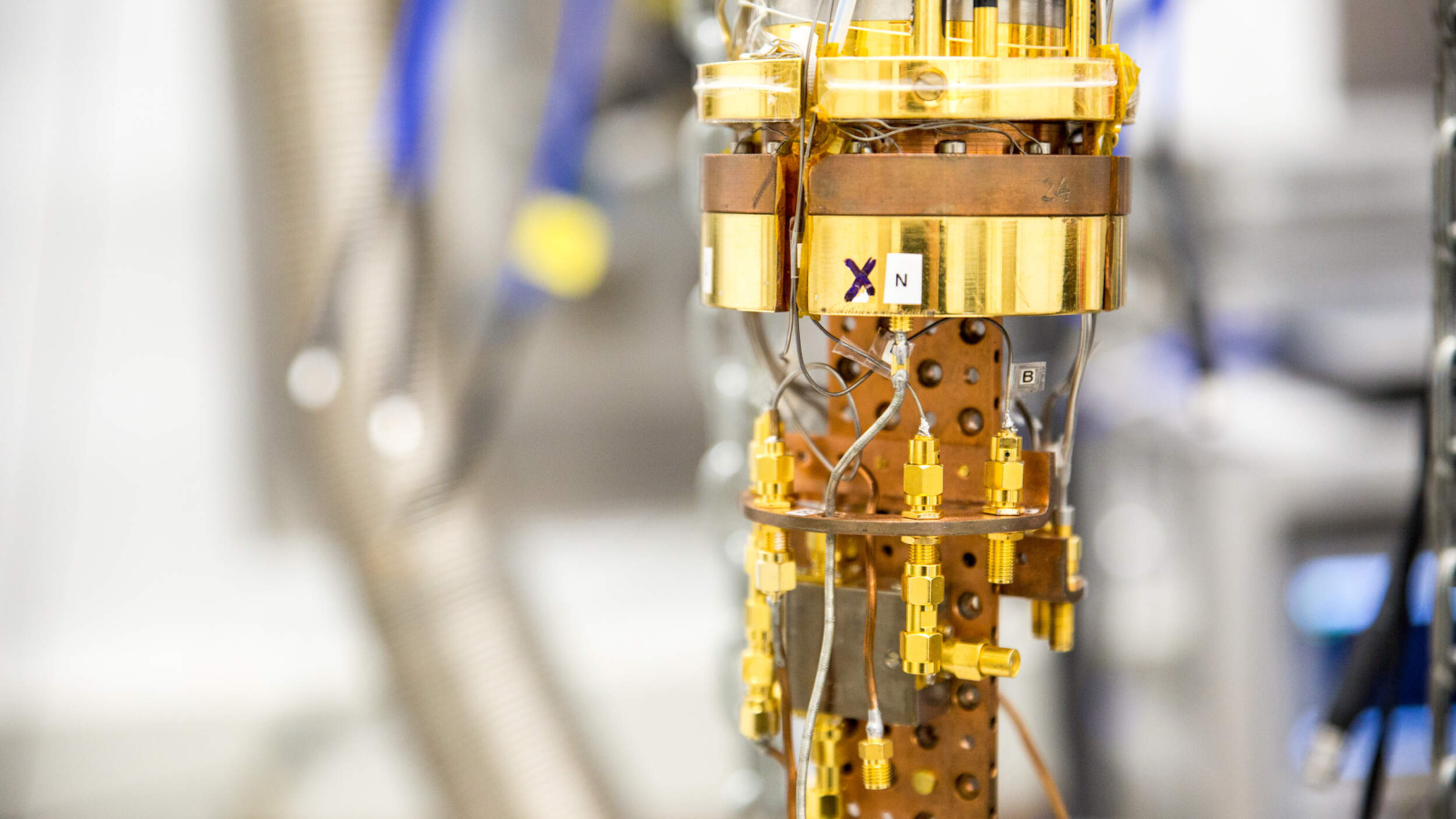

"Unlocking the Future: Time Crystals Set to Revolutionize Quantum Data Storage!"
Time Crystals: A Breakthrough in Quantum Data Storage
Recent research has unveiled promising advancements in the realm of quantum computing, particularly through the exploration of time crystals. A study published on October 16 in Nature Communications demonstrates that time crystals could significantly enhance quantum data storage capabilities, extending the duration of data retention from mere milliseconds to several minutes.
Understanding Time Crystals
Time crystals are unique structures that exhibit periodic behavior in time, rather than in space, as seen in traditional crystals. While conventional crystals have a fixed arrangement of atoms, time crystals spontaneously return to a specific state after regular intervals, a phenomenon that does not require continuous external energy input. This concept, first proposed in 2012, has since led to various experimental realizations.
The recent study, led by Jere Mäkinen, an academy research fellow at Aalto University in Finland, focuses on the interaction between time crystals and mechanical waves. The researchers utilized quasiparticles known as magnons—collective excitations related to the quantum property of spin—formed in superfluid helium-3. By cooling helium-3 to cryogenic temperatures, they created Cooper pairs, which are essential for the formation of these magnons.
Experimental Findings
In their experiments, the team discovered that by inducing mechanical surface waves in superfluid helium-3, they could influence the properties of the magnons without destroying the time crystal. The interaction allowed the time crystal to maintain its integrity for several minutes, a significant improvement over the milliseconds typical of existing quantum memory technologies.
Mäkinen noted, "This is for me the most interesting part… you can really couple time crystals in a significant way to another system and harness the inherent robustness of time crystals." This coupling could pave the way for more stable quantum data storage solutions, which are crucial for the development of practical quantum computers.
Implications for Quantum Computing
In quantum computing, qubits can exist in multiple states simultaneously, a feature that underpins their potential for superior processing power. However, current memory technologies often rely on spin orientations that are highly susceptible to environmental disturbances, leading to rapid data loss. The magnons created in this study, on the other hand, demonstrated resilience against such disturbances, allowing for longer data retention.
The researchers propose that the mechanical surface wave’s imprint on the magnon time crystal frequency could be utilized to "write" quantum data, significantly enhancing the operational capabilities of quantum computers. With longer-lasting quantum memory, more complex computations could be performed before the data deteriorates.
Connections to Optomechanics
The study also draws parallels between time crystals and optomechanics, a field that explores the interaction between light and mechanical resonators. This connection could provide valuable insights into the behavior of time crystals under mechanical influences, potentially accelerating advancements in quantum sensing and control.
Nikolay Zheludev, a professor of physics and astronomy at the University of Southampton, remarked on the study’s significance, highlighting its potential to open new research avenues in nonequilibrium systems.
Future Directions
Looking ahead, Mäkinen expressed interest in exploring various setups to couple mechanically with time crystals, including nanofabricated electromechanical resonators. Such innovations could push the boundaries of quantum memory technology even further, potentially leading to breakthroughs in quantum computing and related fields.
As researchers continue to investigate the properties and applications of time crystals, the implications for quantum technology remain profound, promising a future where quantum data storage is not only feasible but also robust and efficient.