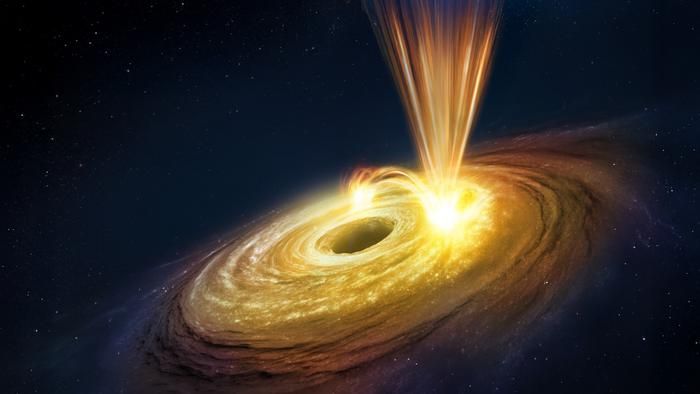

"Unleashing Cosmic Fury: Astronomers Discover Black Hole Generating Winds at Unprecedented Speeds!"
Astronomers Discover Record-Speed Cosmic Winds from Supermassive Black Hole
Date: October 10, 2023
Location: NGC 3783 Galaxy, 135 Million Light-Years from Earth
In a groundbreaking discovery, astronomers have observed a supermassive black hole at the center of the NGC 3783 spiral galaxy unleashing cosmic winds at unprecedented speeds. This remarkable event was triggered by a significant X-ray flare emitted by the black hole, which is located approximately 135 million light-years from Earth.
The Discovery
The black hole, estimated to have a mass equivalent to 30 million suns, generated winds exceeding 37,000 miles per second (60,000 kilometers per second) — a staggering one-fifth the speed of light. This phenomenon marks the first time researchers have recorded such rapid winds emanating from a black hole.
Liyi Gu, an astronomer at the Space Research Organisation Netherlands and the lead researcher of the study, expressed excitement over the findings, stating, "We’ve not watched a black hole create winds this speedily before." The discovery was made possible through the combined efforts of the European Space Agency’s (ESA) XMM-Newton and XRISM X-ray space telescopes.
Mechanism Behind the Winds
The intense X-ray burst and subsequent winds are believed to be powered by the black hole’s complex magnetic field, which underwent a sudden "untwisting." This process is akin to the solar phenomena known as coronal mass ejections, where the Sun releases massive bursts of plasma following the tangling and snapping of its magnetic field lines. However, the scale of the black hole’s activity is vastly larger, making its flares and ejections "almost too big to imagine," according to Matteo Guainazzi, an ESA astronomer involved in the research.
Implications for Galactic Evolution
The study of active galactic nuclei (AGN) like that of NGC 3783 is crucial for understanding the dynamics of galaxies. AGNs are characterized by their bright, energetic regions surrounding supermassive black holes, which can suddenly flare and eject jets of material and winds into space. The researchers believe that understanding the magnetism of AGNs and the mechanisms behind such powerful winds is vital for comprehending the history and evolution of galaxies.
Camille Diez, an astrophysicist and ESA fellow who contributed to the research, emphasized the importance of these findings: "Because they’re so influential, knowing more about the magnetism of AGNs, and how they whip up winds such as these, is key to understanding the history of galaxies."
Future Research Directions
The research team plans to continue their investigations into other flaring AGNs using the same collaborative approach with XMM-Newton and XRISM. By tracking initial flares and analyzing resultant winds, they aim to deepen our understanding of these cosmic phenomena.
The findings were published in a paper on December 9, 2025, in the journal Astronomy & Astrophysics, highlighting the significance of this discovery in the broader context of astrophysics and galactic studies.
As astronomers continue to explore the mysteries of the universe, this discovery serves as a reminder of the dynamic and often violent processes occurring in the cosmos, shaping the galaxies we observe today.